Find / Verify a Tax Preparer

Find or Verify a Tax Preparer

It only takes a few minutes of your time. Find or verify a California-approved tax preparer today.

Verify a California tax preparer before you file. Enter a name or CTEC ID below to check whether a preparer is registered with CTEC—partial spellings are okay.

Note: Not all tax preparers are required to register. CPAs, enrolled agents, and attorneys are exempt.

Search for a tax preparer

A000001
GARY
PARK
WALLACE
Preparer Information:
1538 OLD RIVER RD
714-871-7557
Expired as of 11/01/2021
No Disciplinary Actions Taken
Bond Information:
American Contractors Indemnity Company
Bond Number: 66405
Effective Date: 01/01/2019
Expiration Date: 01/01/2023
No Paid Bond Claims Reported
ctec-questionmark-search
Can’t Verify Your Tax Preparer?
Can’t find what you’re looking for? Check your spelling. You should also check if the individual is a CPA, enrolled agent, or an attorney. Those three professionals are exempt from CTEC registration.
If you still can’t verify the individual’s credentials, please use the button on the right to file a complaint.

FAQs

The Tax Preparation Act defines California certified public accountants (CPAs), IRS enrolled agents (EAs), CTEC-registered tax preparers (CRTPs), and attorneys with the State Bar of California as approved to prepare tax returns as a profession.

Taxpayers should verify a tax preparer’s credentials before allowing someone to prepare their tax return and anytime there is a change in the preparer’s business, registration status, or qualifications. Because registrations and licenses can expire, be suspended, or revoked, it is a good practice to verify credentials each tax season.

In California, taxpayers can verify different types of tax preparers through the appropriate regulatory agencies:

  • CTEC-registered tax preparers (CRTPs): CTEC Verify a Tax Preparer tool
  • Certified Public Accountants (CPAs): California Board of Accountancy License Lookup
  • Enrolled Agents (EAs): IRS Directory of Federal Tax Return Preparers
  • Attorneys: State Bar of California Attorney Search

Taxpayers may also want to review any publicly available disciplinary history before working with a preparer. Verifying a preparer’s credentials can help confirm that the individual is authorized to prepare tax returns for a fee and is meeting California registration, licensing, or professional standards.

To verify a tax preparer’s credentials, taxpayers should try to obtain the preparer’s full name, business name, credential type, and, if available, their license, registration, or identification number. Having this information can help ensure accurate search results when using verification tools.

Different types of tax preparers in California can be verified through different agencies:

  • CTEC-registered tax preparers (CRTPs): Taxpayers can search using the preparer’s name, business name, city, ZIP code, or CTEC ID number through the CTEC Verify a Tax Preparer tool.
  • Certified Public Accountants (CPAs): Taxpayers can verify a CPA using the individual’s name or license number through the California Board of Accountancy License Lookup.
  • Enrolled Agents (EAs): Taxpayers can search by name and location through the IRS Directory of Federal Tax Return Preparers.
  • Attorneys: Taxpayers can verify an attorney using the individual’s name or bar number through the State Bar of California Attorney Search.

Taxpayers should also confirm that the preparer’s registration or license is active and review any publicly available disciplinary history before working with a tax professional.

Hiring an unqualified tax preparer will increase your chances for tax fraud, penalties, and additional taxes.

Taxpayers can report unregistered tax preparers here. All reports go directly to the California Franchise Tax Board (FTB) for further investigation. That said, any penalties or additional taxes taxpayers face as a result of the tax preparer, is still their responsibility.

CTEC-registered tax preparers (CRTPs) are the only tax professionals in California required to maintain a $5,000 surety bond. CRTPs must provide clients with their bond information, including the name of the surety company and bond number.

If this information was not provided, taxpayers can verify a preparer’s registration and bond information through CTEC’s verification page at CTEC Verify a Tax Preparer or by calling CTEC at 877.850.2832.

Taxpayers who suspect fraud, misconduct, or illegal activity by a tax preparer in California can report the individual to the appropriate agency based on the preparer’s credential type and the nature of the complaint.

Potential issues to report may include preparing fraudulent tax returns, identity theft, filing returns without permission, operating without proper registration or licensing, or refusing to provide copies of tax returns.

Complaints and reports can be submitted to the following agencies:

  • Unregistered or illegally operating tax preparers: CTEC File a Complaint Against a Tax Preparer
  • Certified Public Accountants (CPAs): California Board of Accountancy
  • Enrolled Agents (EAs): IRS
  • Attorneys: State Bar of California

Taxpayers may also report suspected tax fraud or illegal tax preparation activity directly to the California Franchise Tax Board through the FTB Tax Fraud Hotline and Reporting Information.

When filing a complaint, taxpayers should provide as much documentation as possible, including copies of tax returns, payment records, emails, advertisements, and correspondence with the preparer.

Disciplinary actions against tax preparers in California can vary depending on the preparer’s credential and the nature of the violation. Actions may be taken by the California Tax Education Council (CTEC), the California Franchise Tax Board (FTB), the IRS, the California Board of Accountancy, or the State Bar of California.

Potential disciplinary actions may include:

  • Suspension or revocation of a CTEC registration, CPA license, EA status, or law license
  • Denial of a CTEC registration or renewal applications
  • Public disciplinary notices
  • Injunctions prohibiting an individual from preparing tax returns

California law also allows penalties of up to $5,000 for unregistered preparers who illegally prepare tax returns for a fee.

Taxpayers can review disciplinary actions involving CTEC registrants throug

California taxpayers are generally not penalized simply for using an unverified tax preparer. However, there can be significant risks and consequences if the preparer is unregistered, fraudulent, or improperly credentialed.

Even when a paid preparer completes the return, taxpayers remain legally responsible for the accuracy of the information filed with the IRS and the California Franchise Tax Board (FTB). If a preparer files an inaccurate or fraudulent return, taxpayers may face:

  • Additional taxes owed
  • Interest charges
  • IRS or FTB penalties
  • Delayed refunds
  • Increased audit risk
  • Potential identity theft or fraud issues

California law requires paid tax preparers to be properly registered or licensed. Individuals who illegally prepare tax returns for a fee may face penalties of up to $5,000 from the California Franchise Tax Board.

If taxpayers suspect their tax preparer may be fraudulent, they should act quickly to protect their personal information, tax records, and financial accounts.

Recommended steps may include:

  • Review copies of filed tax returns and compare them against personal records for inaccuracies, unauthorized changes, or suspicious refund information.
  • Request a complete copy of the tax return and all supporting documents if one was not provided.
  • Verify the preparer’s credentials and registration status through the appropriate agency (CRTPs: CTEC Verify a Tax Preparer; CPAs: California Board of Accountancy License Lookup; EAs: IRS Directory of Federal Tax Return Preparers; Attorneys: State Bar of California Attorney Search).
  • Report suspected fraud or misconduct to the appropriate agency (unregistered preparers and CTEC registrants: CTEC Tax Preparer Complaint Form; CPAs: California Board of Accountancy Complaint Process; EAs and other federal preparers: IRS Return Preparer Complaint Process; Attorneys: State Bar of California Complaint Process).
  • Report suspected tax fraud directly to the California Franchise Tax Board through the FTB Tax Fraud Reporting Information.
  • Monitor IRS and financial accounts for suspicious activity.

Taxpayers should keep copies of returns, receipts, emails, contracts, and any communication with the preparer, as these documents may be needed during an investigation.

Using an unregistered or illegally operating tax preparer can expose taxpayers to financial, legal, and identity theft risks. While taxpayers are generally not penalized simply for hiring an unregistered preparer, they remain legally responsible for the accuracy of their tax return.

Potential consequences may include:

  • Incorrect or fraudulent tax returns
  • Delayed refunds
  • Additional taxes, penalties, and interest assessed by the IRS or California Franchise Tax Board (FTB)
  • Increased risk of audits
  • Identity theft or misuse of personal information
  • Difficulty resolving disputes or obtaining records

California law requires individuals who prepare tax returns for a fee and are not attorneys, CPAs, or enrolled agents to register with the California Tax Education Council (CTEC). Preparers operating illegally may face penalties of up to $5,000 per violation.

No. The CTEC Verify a Tax Preparer tool only provides information for tax preparers who are registered with the California Tax Education Council (CTEC). It does not verify tax preparers licensed or registered in other states.

Tax preparers operating outside of California may be regulated through different state agencies, licensing boards, or federal programs. Taxpayers seeking to verify an out-of-state preparer should contact that state’s appropriate regulatory agency or use applicable IRS verification resources.

TEC is a state-authorized nonprofit responsible for administering California’s registration program for non-exempt tax preparers.

CTEC does not directly “license” tax preparers like a government agency would, but it plays a central regulatory oversight role under California law by ensuring qualifying tax preparers meet state requirements before preparing returns for a fee.

CTEC’s primary responsibilities include:

  • Registering tax preparers who are not CPAs, attorneys, or IRS Enrolled Agents
  • Verifying education compliance, including required qualifying and continuing education courses
  • Maintaining an active public database so taxpayers can verify preparer registration status
  • Enforcing bond requirements for registered preparers
  • Partnering with the California Franchise Tax Board in investigating complaints and violations related to unregistered tax preparation activity
  • Referring serious violations to state enforcement agencies when appropriate
  • Educating consumers about how to identify legitimate, compliant tax preparers

The broader purpose of the program is consumer protection — helping reduce fraud, unqualified tax preparation, and deceptive practices within California’s paid tax preparation industry.

Taxpayer Tips

Thousands are operating tax preparation businesses in California without a state-required credential. Taking a few minutes to conduct an interview with your prospective tax preparer will help protect you against fraud.

In California, only CPAs and their employees, attorneys with the State Bar of California, tax preparers registered with CTEC, or enrolled agents with the IRS can prepare tax returns for a fee. All professionals should willingly provide proof of their license, enrollment, or registration. CTEC registrants are required to have their certificate in a visible location.

CTEC Registered Tax Preparers (CRTPs)
  • Look for a CTEC certificate in their office
  • Search “Verify a Preparer” on the CTEC website or call 877.850.CTEC (2832)
  • Ask to see proof of a $5,000 surety bond
Certified Public Accountants (CPAs)
  • Look for a wall certificate in their office
  • Go to cba.ca.gov and click on “License Lookup”
Enrolled Agents (EAs)
  • Look for a wall certificate in their office
  • Call the IRS Office of Professional Responsibility at (313) 234-1280 or verify through the IRS website at irs.treasury.gov/rpo/rpo.jsf
Attorneys
  • Look for a wall certificate in their office
  • Go to calbar.org and click on “Attorney Search”

Reasonable fees vary, but the cost of the tax preparation should never be based on the refund amount. It should be based on the complexity of your tax return.

Don’t be shy. Filing your tax return is the most important financial transaction you do each year. It is important you feel comfortable with the professional you hire.

Legitimate tax preparers will be available for clients year-round.

Refunds should go directly to you. Beware of tax preparers who claim refunds should go to their bank account instead of yours.

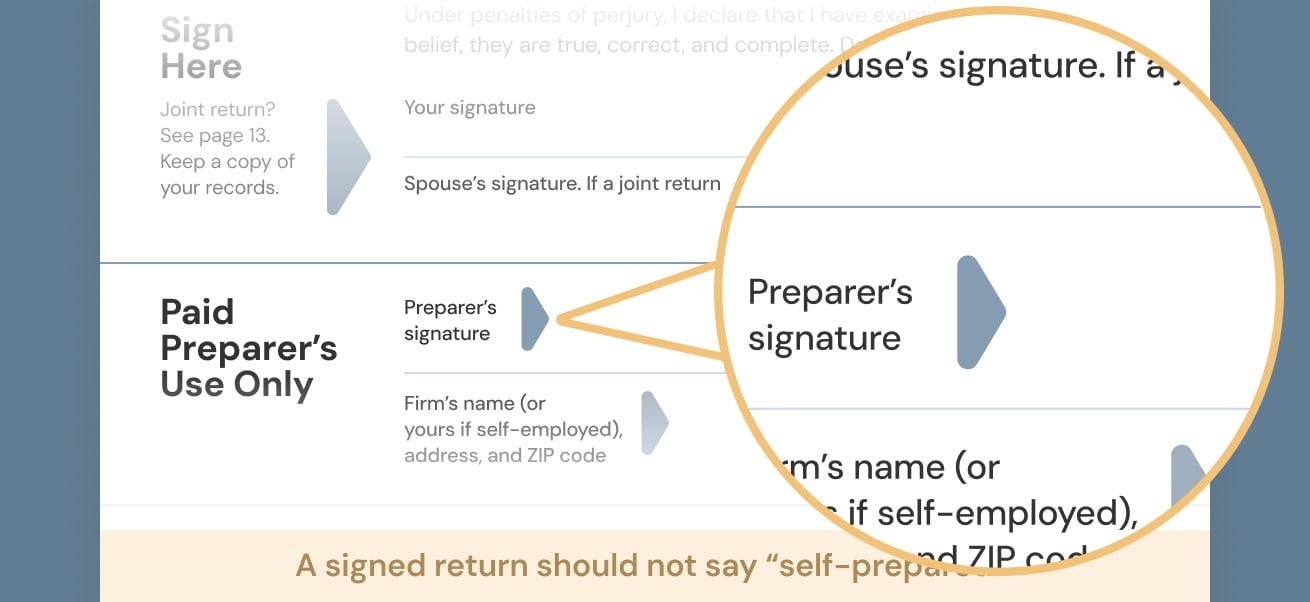
The answer should always be YES. Paid tax preparers are also required to obtain an IRS Preparer Tax Identification Number (PTIN) and include it on all tax returns they prepare for clients. Tax preparers who sign tax returns with a business label should also be questioned. A signature (typed or handwritten) and PTIN is required. Business labels do not meet federal or state standards.

Do you need to file a complaint about a Tax Preparer?

Tax form with signature fields; preparer's signature field is magnified.

More tips and warning signs
  • Anyone advertising guaranteed refunds may not be a reputable tax preparer. The only guarantee a tax preparer can provide is that you will either pay the least amount owed or get the most amount allowed based on current tax laws.
  • Beware of tax preparers who take a percentage of your refund as compensation.
  • The tax preparer should offer you an opportunity to ask them questions about your tax return before you sign.
  • Double check if your name, address, and social security number(s) are accurate. Also review the list of deductibles and dependents. This is where most fraud happens. In the most obvious lists. You may not know tax law, but you know your life. Always double check.
  • Do not be embarrassed to ask questions.
  • Verify they will assist you with any letters from the IRS or California Franchise Tax Board (FTB).
  • The filed tax return should be completed by a computer, typewriter, or written in ink—not in pencil.
  • Never sign a blank tax return.

Quick Links

Below are quick links to file complaints, find educational resources, or verify tax preparers who are exempt from CTEC registration.
Other Helpful Links